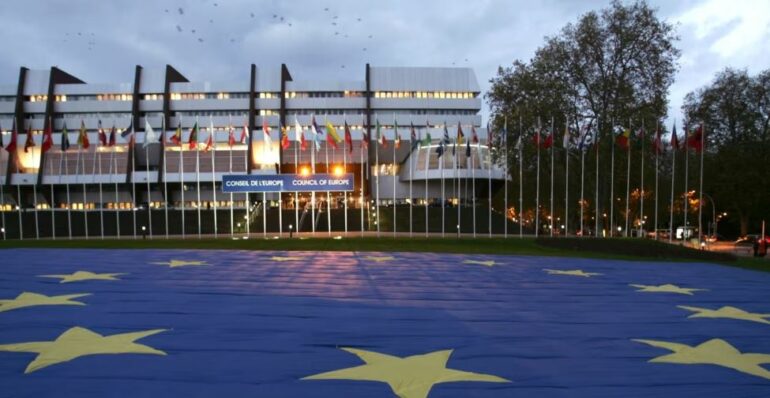



Kosovo's consultations with the European Union on amendments to the Law on Specialist Chambers could serve as an opportunity to restore the trust of European partners and give impetus to Kosovo's membership in the Council of Europe – a process that has been blocked for more than two years.
Some experts on European affairs believe that the way Kosovo handles these changes could demonstrate its commitment to the rule of law and respect for international obligations – issues of importance for membership in the Council of Europe.
Kosovo was close to joining this organization in 2024, but the process stalled due to political demands from several member states, mainly related to the Association of Serb-majority Municipalities.
Although the consultations on the Law on Specialist Chambers and membership in the Council of Europe are two separate processes, experts assess that they are politically linked.
Ramadan Ilazi, from the Kosovo Center for Security Studies (KCSS), says that many of the states that decide on Kosovo's membership in the Council of Europe are also those that closely monitor the fulfillment of its international obligations.
However, resolving the dispute with the EU over legal changes would not automatically mean unblocking membership.
The final decision remains in the hands of the Council of Europe member states, while their political demands, especially those related to the Association, remain unresolved.
A test for relations with Europe
On November 5, European Commissioner for Enlargement, Marta Kos, confirmed that the European Union is holding talks with the Government of Kosovo on amendments to the Law on Specialist Chambers, also known as the Specialist Court.
The government, however, has not publicly provided details about these talks, nor has it responded to Radio Free Europe's questions about their progress and content. The EU says it is holding a dialogue with Kosovo on changes to the Law on Special
Prime Minister Albin Kurti, speaking on November 10 at the Paris Peace Forum, did not refer to legal changes, but said that dissatisfaction with the Special Court's verdict should be addressed through appeal.
The changes to the law, initiated by the Democratic Party of Kosovo, were approved in the Assembly on October 6, following protests against the first-instance conviction of four former leaders of the Kosovo Liberation Army.
On September 16, the Special Court in The Hague sentenced former President Hashim Thaçi and former Speaker of Parliament Jakup Krasniqi to 25 years in prison each, former Speaker of Parliament Kadri Veseli to 18 years, and former MP Rexhep Selimi to 13 years for war crimes.
The legal amendments aim, among other things, to limit the jurisdiction of the Special Court and amend several provisions related to procedures and sentences.
The EU opposed them, warning that they conflict with Kosovo's international obligations and could undermine the independence of the court.
On October 22, Kosovo President Justina Shiroka Pula returned the law to the Assembly for reconsideration.
According to the Rules of Procedure of the Assembly, the responsible committee has four weeks from the adoption of the law to prepare the report for the plenary session.
The EU welcomed the President's decision and requested to be consulted on any further changes, in line with the 2014 exchange of letters between Kosovo and the EU.
In its November 4 report, the European Commission also warned that the proposed changes raise serious concerns about Kosovo's international obligations, the independence of the judiciary, the protection of victims and witnesses, and accountability for war crimes.
Engjëllushe Morina, senior policy researcher at the Berlin-based European Council on Foreign Relations, warns that changes to the Law on Specialist Chambers could become the next obstacle for Kosovo on its path to the Council of Europe.
She believes that now, when Kosovo has stable institutions, it should intensify cooperation with the EU and diplomatic engagement for European integration.
"Kosovo has no time to waste. Given the political context in Europe, things are moving very quickly and the year 2027, with national elections in many member states, could change the political constellation in the EU. This could lead us to a situation where Kosovo will have even less support," Morina assessed for Radio Free Europe.
For Ilazi, meanwhile, consultations with the EU could be an opportunity to prove that Kosovo is ready to address the concerns of European partners through dialogue and institutions.
"If changes are made unilaterally, existing reservations will only be strengthened. If they go through serious consultations, Kosovo strengthens its argument" for membership in the Council of Europe, he says.
Ilazi believes that concerns about the way the Specialist Chambers have administered the judicial process are legitimate, but that they should be addressed through dialogue and institutional mechanisms, not through unilateral legal changes.
This position was also reflected in a joint statement, published on November 1, which Ilazi signed together with 20 academics, activists and civil society representatives from Kosovo and abroad.
In it, the signatories requested that concerns regarding the trials in The Hague be addressed while respecting the rights of the accused, justice for victims, and Kosovo's international obligations.
Ilazi says that justice for the victims should not create the impression that the liberation war itself is being judged, while emphasizing that the victims and their families, from all communities, deserve truth and accountability.
"These principles must be respected together and without discrimination. This is also the message that Kosovo must send to the Council of Europe," he says.
According to him, addressing sensitive issues through institutions, expertise and dialogue would be an important message for Strasbourg and European capitals.
Association, the remaining obstacle
Beyond the debate over the Special Court, another political obstacle continues to hold Kosovo's membership in the Council of Europe in suspense: the Association of Serb-majority Municipalities.
On April 16, 2024, the Parliamentary Assembly of the Council of Europe recommended Kosovo's accession, with 131 votes in favor, 29 against and 11 abstentions.
But, a month later, its application was not included in the agenda of the meeting of the Committee of Ministers – the body that makes the final decision on membership.
Several member states, including Germany and France, requested that Kosovo submit the draft statute of the Association, prepared by the EU, for assessment to the Constitutional Court, as proof of commitment to the agreements reached in the dialogue with Serbia.
The Kosovo government initially rejected the request. Then, the then Minister of Foreign Affairs, Donika Gërvalla, announced that she had sent a letter to the Council of Europe, announcing that the draft statute would be sent to the Constitutional Court by the end of May 2024.
But this was not enough to unblock the process.
He believes that the positive recommendation of the Parliamentary Assembly proved that Kosovo met the main standards for accession.
"So, today the problem is not that Kosovo is unprepared. The problem is the lack of political trust. This trust can be built, but it requires continuous and coordinated work," says Ilazi.
There is no public confirmation that the countries that made the Association a political condition have abandoned this request.
Radio Free Europe/Radio Liberty has contacted the Kosovo Ministry of Foreign Affairs to ask whether the Association remains a condition for membership and what steps are required to secure the support of member states. It has asked the Council of Europe for clarification on the remaining conditions and the possibility of considering the application at the next ministerial meeting.
Neither institution has responded by the time of publication of the article.
The Association – both an obstacle and a bridge to the EU
According to Morina, the Association condition "is still there," while it remains to be seen how Kosovo will address this issue in the dialogue with Serbia.
Ilazi also says that for some European countries, the Association remains an indicator of Kosovo's readiness to fulfill the obligations assumed in the dialogue.
He believes that sending the draft statute to the Constitutional Court should not be seen as a political concession, but as a mechanism to guarantee the compatibility of any solution with the constitutional order of Kosovo.
"It is a constitutional procedure that protects Kosovo itself, because the Court guarantees that any solution will be in accordance with the Constitution and the unitary character of the state. Kosovo must take this step, but not in silence and not as an isolated action," Ilazi emphasizes.
According to him, Kosovo must first secure political guarantees from key European partners and the United States that such a step would pave the way for the consideration of its application.
Could 2027 be a new opportunity?
On November 10, Montenegro took over the six-month chairmanship of the Committee of Ministers of the Council of Europe, succeeding Monaco.
Its chairmanship will conclude on 12 May 2027, when the next annual ministerial meeting is scheduled to be held in Montenegro.
But, there is still no confirmation that Kosovo's application will be included in the agenda of this meeting.
For the admission of a new member, the Committee of Ministers must secure the support of two-thirds of all representatives entitled to participate in this body, according to the Statute of the Council of Europe.
What does Kosovo benefit from the Council of Europe?
This means that, in addition to meeting the required standards, Kosovo also needs broad political support from member states.
For Ilazi, including the application in the 2027 agenda requires coordinated diplomatic engagement and concrete steps in relation to European partners.
“This requires three things: improved relations with the EU, including a consulted solution to the Specialist Chambers law, credible steps in dialogue, and a coordinated diplomatic campaign with hesitant states,” he says.
Membership in the Council of Europe would open the way for Kosovo to the European system of human rights protection, including the possibility for individuals under its jurisdiction to address the European Court of Human Rights. /REL/