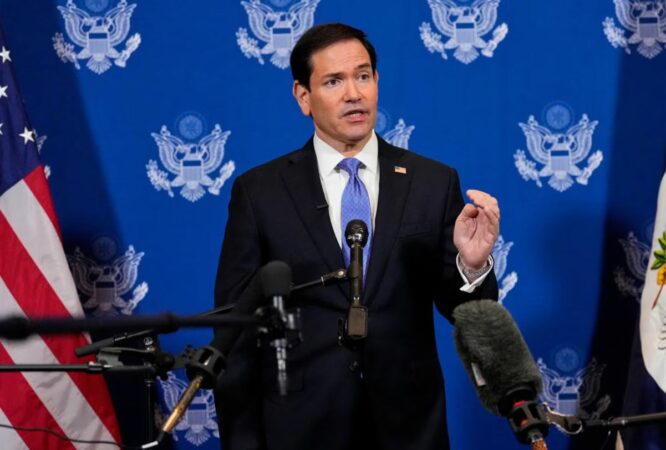



US Secretary of State Marco Rubio will visit Iceland, Greece and Portugal from October 5 to 8 for talks on security, defense, energy, economic cooperation and technology.
The visit comes at a time when NATO allies are facing growing concerns about Russia's military activity and ongoing instability in the Middle East.
Rubio will begin his visit in Reykjavik, where he is expected to discuss Arctic security and economic cooperation with Icelandic officials.
Next, he will travel to Athens for the sixth US-Greece Strategic Dialogue.
On the agenda will be cooperation in the fields of defense, energy, regional security, Ukraine and the Middle East.
In Lisbon, Rubio's talks will focus on defense, economic development and technology cooperation, according to a statement from the US State Department.
The three stops reflect different areas of US cooperation with NATO allies – from Iceland's role in North Atlantic and Arctic security, to Greece's position in the Eastern Mediterranean and Portugal's long-term importance to US military operations in the Atlantic.
Iceland: Security and the Arctic
Iceland does not have a standing army, but has long cooperated with the United States and NATO in the field of security, due to its strategic position in the North Atlantic.
Two former US ambassadors to Iceland, who spoke to Radio Free Europe on condition of anonymity, said Rubio can expect readiness from Reykjavik to deepen security cooperation.
However, according to them, he must also take into account the concerns of a country that attaches great importance to its independence.
"Icelanders are an extremely independent people," said one of the former ambassadors, adding that cooperation between the US and Iceland in the field of security has continued since the Russian invasion of Crimea in 2014.
Robert Gerber, a former US diplomat who served at the US Embassy in Iceland, said Rubio's visit could serve to advance commitments discussed at a meeting of Arctic countries, held in September on the sidelines of the UN General Assembly.
In those discussions, Arctic partners pledged to take more responsibility for their own security and for protecting critical infrastructure.
Gerber also cited his experience in Iceland to illustrate the security concerns facing the country.
"When I was regularly in Iceland, Russian planes, bombers or other aircraft would fly towards Iceland, circle the island and then return, just to see how quickly the NATO planes would take off," Gerber told Radio Free Europe.
"The threat there is real and has existed for a long time," he said, adding that submarine activity in the region also continues to be a concern.
Iceland's contribution to NATO differs from that of larger allies, according to Gerber.
The country hosts the Keflavik Air Base, has provided support to Ukraine and, through the Coast Guard, provides maritime and search and rescue capabilities.
Gerber said that protecting undersea telecommunications cables connecting North America to Europe could be another area where cooperation could be expanded.
Russians in the Arctic
"They, of course, need to be reinforced and protected, because the Russians are carrying out all kinds of activities in the Arctic," he said.
According to Gerber, the Icelandic Coast Guard, including its ships and helicopters, could also play an important role in the event of a crisis in the Arctic.
Gerber said he doesn't expect Rubio to convince Iceland to make any major changes in defense spending.
"Iceland's economy is relatively small," Gerber said, adding that the country's approach to security is also influenced by its independent political stance.
Eric Green, a former White House National Security Council official who also served as deputy chief of diplomatic mission in Iceland, said Icelandic officials will also seek guarantees from Washington.
"It's positive that Secretary Rubio is visiting NATO countries," Green told Radio Free Europe, adding that Icelandic officials will want assurances that Washington is no longer interested in making claims to Greenland, based on what he called "baseless accusations."
Green also said that Iceland, a strong supporter of Ukraine, would welcome signals that Washington intends to do more to help Ukraine and Europe as Russia continues its war.
The Arctic has become an area of increasing competition, as melting ice is opening up new sea routes and increasing interest in the region's resources.
The former ambassador said Russia has strengthened its military presence along the Arctic coast, while China has aimed to expand its presence in Iceland through ports, research projects and other initiatives.
Greece: Defense, energy and regional security
In Athens, Rubio will lead the American delegation to the sixth US-Greece Strategic Dialogue, on October 6 and 7.
The dialogue, launched in 2018, serves as a framework for cooperation in the fields of defense, energy and other issues.
The talks are expected to discuss the facilities and support that Greece offers within the framework of the Agreement on Mutual Cooperation in Defense, as well as developments in Ukraine and the Middle East.
Geoffrey Pyatt, former US assistant secretary of state for energy resources and former US ambassador to Greece and Ukraine, said the dialogue was created as a way to advance bilateral cooperation, regardless of other relations in the region.
"When we created the Strategic Dialogue during my tenure as ambassador, the idea was to create a forum to advance the broad agenda of bilateral cooperation, regardless of other regional relationships," Pyatt told Radio Free Europe.
He said that military cooperation, energy opportunities, and ties between the citizens of both countries, including education and investment, have remained stable under both Republican and Democratic administrations.
Pyatt also highlighted Greece's commitment to its European and transatlantic ties.
"Greece remains strongly committed to its European identity, including its unwavering commitment to transatlantic relations," he said.
Rubio's final stop will be Lisbon, where, according to the State Department, he will discuss defense, economic development and technology cooperation with Portuguese leaders.
An important part of Portugal's cooperation with the US in the field of security is related to the Azores Islands, where the Lajes air base has long served as an important logistical and fuel supply point for US military operations in the Atlantic. /Rel