By: BEN ANDONI*
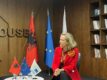
TIRANA – Serbian writer Jasmina Mihajlovic, wife of the late Serbian writer Milorad Pavic, was enthusiastic about the interview for the Albanian media. Not just for the interest in her husband's creativity, translated on all continents and in more than 35 languages, but for the culture-loving and uncomplicated level of Albanians. For Serbia, it was strange that the Albanian translation of "Dictionary of the Khazars" came out shortly after its re-publication in the native language. And "Dictionary of the Khazars" was a book included in the literary reading program of the Serbian school!, she announces. Recently, "Painted Landscapes with Tea", one of the best creations of his corpus, in a completely experimental literature by the master of the European Baroque, was translated in Tirana. In this interview, Jasmina shared her opinions about language, Pavić's way of working, culture and many other things. Today, she deals with his literary legacy, and the Center named after Pavić, which she runs, has become a point that Serbs use as a cultural attraction during the European Heritage Days. She has a distinguished career, but her name became even more famous when she was associated with Milorad Pavić, one of the prides of Slavic Balkan literature. In her career, she worked on a project entitled "Serbian Literary Criticism" in Belgrade at the Institute for Literature and Art, and later served as the director of the Council for the Promotion of Serbian Culture Abroad. Her prose, criticism and essays have been translated into English, Russian, Slovenian, Ukrainian and Greek, while she writes editorials for several local magazines.
Perhaps in all countries, a dull hatred of the average over the non-average governs more or less.
and success. Usually this kind of mobbing, let's call it that, calms down with the death of such a personality (like Pavic), she says among other things, while adding below that: "However, let's not forget that Serbia and Albania were taught by socialism to promote a culture of forgetfulness". And, for Jasmina Mihajlovic, the fact remained incomprehensible how the Albanians published her husband's masterpiece, which gave him such a name in European papers...
Some literary Serbs still do not believe that there are already several books by Milorad Pavic, translated into Albanian in Tirana. At the same time, several Serbian writers of contemporary and classical literature have also been translated. Why is this still strange for Serbia and Serbs, in your opinion?
"While he was alive, Milorad Pavic (1929 – 2009) was not translated into Albanian. And this was the only European language that had not been translated until then!"
In the Balkans, publicly, as always, a masculine ideological and political model from the past prevails, while economic and cultural exchange flourishes completely independently of atavistic impulses.
But for Serbia, it was strange that the Albanian translation of the “Dictionary of the Khazars” came out shortly after its re-publication in the native language. And the “Dictionary of the Khazars” was a book included in the literary reading program of the Serbian school. This was absurd! However, the fate of Milorad Pavic’s literary work after his death was such that it was considered much more welcome in all languages and continents than in his own hometown and country. It is about absolute envy and hostility towards his success. Perhaps in all countries a dull hatred of the average over the mediocre and the successful more or less reigns. Usually this kind of mobbing1, let’s call it that, calms down with the death of such a personality. In the case of Milorad Pavic, the exact opposite happened. Well, for me personally, this is strange and incomprehensible.
However, let us not forget that Serbia and Albania were taught by socialism to foster a culture of forgetting.
People who have read “Landscapes Painted with Tea” in our country have been amazed by the incomparable style and rhythm of the book. How did Mr. Pavic create this style? Please, can you explain something to us about his writing style?
"It's about those unusual sentences of his! About the use of fantasy, dreams, then the methods and techniques of postmodernism, and then also about his great knowledge - literary and historical. Oh, don't forget that Pavic was a university professor, an expert on the Baroque and Serbian folk literature, and who also dealt with stylistics.
"I think the biggest influence on Pavic's style was from the oral literature of the Balkans, then medieval literature, and the fact that he had the freedom to connect them with a very modern style and knew how to give the effect of endless layers of narrative. He was an experimenter in literature."
Once again: How do you experience his translation of the book into Albanian?
“I was really impressed with the luxurious edition of the “Khazar Dictionary” in Albanian. The book looks powerful. Then, the editions of the two books “Khazar…” and “Strašne ljubavne price”, which was translated by Mr. Nikola Sudar (recently, I remember that he also won an international award for translation) were done in a very professional manner. In any case, I was satisfied at all levels of cooperation with the publisher of Onufri”.
Did Mr. Pavic know any Albanian writers when he was alive, like Ismail Kadare for example?
"Yes, he knew Ismail Kadare. They had seen each other at conferences and meetings in the literary world. He always emphasized that he was impressed by how the Albanian state takes care of its author, even though he lives abroad."
What did he really think about Albanians? Do you two have any kind of connection to our country?
"Albanians during the 20th century were our neighbors. I was born in Niš and I had two Albanian girls in my class with whom I often socialized. But back then we were Yugoslavs, and the fact of what nation you were from and what religion someone had was generally not relevant. A person had importance behind their name. A human being, that is.
On the other hand, we often, Pavic and I, went to Corfu and looked back towards Albania, enjoying the landscape of the mighty mountains, looking from the air at this compact geographical piece of the Balkans, which ended with beautiful endless sandy beaches. It was then that I first had the desire to visit this country.
Since we always stayed in the same hotel in Corfu, which is perched on top of a cape, we called it the “room with a view of Albania.” It was wonderful.
Besides, we both loved the description of Albania made by the old Serbian writer and traveler of the Age of Enlightenment – Dositej Obradovic. Pavic even wrote the foreword to Dositej's famous book 'Zivot i dozivljaji'”2.
I have read some of your writers who spoke about Mr. Pavic as they had known him in everyday life. He was completely different from what they saw, compared to others. Can you briefly explain to us how he spent his time or a typical day?
What did he usually do or what did he read the most?
What time of day did he use to write?
“He didn’t have a set time of day to write. On the contrary, it must be said that he wrote constantly, day and night. Everywhere. In notebooks, on napkins, in the blank spaces of the pages of the books he read… Some friends jokingly say that Pavic even wrote on confetti3! But, he wrote by hand and with a pencil, in all positions, including lying down. Then everything was put into the computer. And then he was almost military disciplined, when the book would progress in the process. He worked on it for a long time. If, for example, he solemnly announced to us that he had finished the manuscript, this would mean that he would have another year to work on it!
He read absolutely everything! Passionate reader. Fiction, old and new, he followed carefully what was happening in world literature (because he spoke English, French and Russian), he read essays, historiography, modern horror, Bestsellers, although he may have read his old favorite writers endlessly!
We loved to travel to the great galleries of the world, frequent good restaurants, bars, we enjoyed nature walks, traveling, we played computer games for adults together, we loved to look at the facades in Belgrade and other cities. We lived very intensely. Constantly in fifth gear.
You said earlier that Pavic lives more outside Serbia than in Serbia itself. Do you think that today's Serbs do not respect him and why?
"We need to divide the readers and the cultural scale in Serbia. Serbian readers love Pavic. A silence has been created, which is worse than when you hate or attack someone. I think it is enough to say that he has a monument in the center of Belgrade from the Azerbaijani side, a memorial bust in the house where he lived – from the Russians! But Pavic was born in Belgrade and he left everything to the city of Belgrade."
I want to be correct about one fact. Is it true that at the present time the Serbian Academy and cultural institutions are indifferent to Pavic?
"The attitude of the Serbian Academy of Arts and Sciences has improved somewhat since the new management took over this institution. But the general attitude of cultural institutions has remained the same. Silence, indifference, carelessness and a tendency to forget."
Currently, Pavic, after his death, is becoming much more popular in the world than he was during his lifetime. His books have been translated, theatrical performances are being performed, seminars are being organized in universities around the world, doctoral theses are being defended... In France, the “Dictionary of the Khazars” is now being reprinted, it even sold out in a month and the book is on the bestseller list. In China, the same book was declared the “Book of the Year” two years ago.
Why is the theme of past centuries and religious themes so prominent in his work? Is the designation: "The last writer of the Hilandar tradition" true?
"I don't understand the question?! Every writer chooses the topics that suit him the most! But I think that in Pavic you have a sense of infinity, of timelessness, and it is not clear to the reader whether it is about the deep past or the future. I am talking, of course, about the entire literary corpus of Pavic.
Pavic was not a writer of current politics, which seems quite clear, but not even a writer of purely historical topics (like Ivo Andri?), he was first and foremost someone who tried to move forward in literature, to experiment. And he was also a storyteller of races, something like a rhapsodist, something like a male Scheherazade, so to speak…
Pavić called himself the “last Byzantine,” because his literary work is dominated by the spirit of the Balkans, the Mediterranean, and Central Europe. Because through his work, an entire geographical area is shown that before the Ottoman conquest belonged to a huge part of the Byzantine Commonwealth.
Western Europe, in its narrow and ancient Eurocentrism, forgets the birth of the former Eastern Roman Empire, Byzantium, the cradle of modern Christian Europe.
Personally, having recently stayed in Azerbaijan and Georgia, I am convinced that these are European countries, which really have geographical divisions, but they are not visible, not even in the weather forecast! And how can they be left out of the consciousness of the Central European! My new book, “Na obali Hazarskog mora”, which constitutes a special itinerary for Azerbaijan, talks about a part that I was surprised to escape to Baku that this was Europe. I had a prejudice. Now they have been dispersed.
When "Dictionary of the Khazars" became a bestseller, critics around the world called it "the first novel of the 21st century." Do you think that now that we are in the 21st century, this century is not so good for Milorad Pavic?
"I can't believe it. I have published almost 99 of Pavic's books worldwide since his death. I even managed to have them in e-book version, then as electronic books, and I have almost all of Pavic's work in English translation. Now the Russians are preparing to promote his novels in electronic form in Russian, and the Chinese are making the "Khazar Dictionary" in digital form. When it comes to the "Khazar Dictionary", the electronic form is more suitable for it, because through the reader you can jump from one instruction to another, which was not so comfortable, let's say, when the book is in analog form, in the form of printed paper, in the typewritten form.
Therefore, the "first novel of the 21st century" has taken on the clothing that belongs to the 21st century, taking on the opportunity for a truly linked way of reading in a digital environment.
Young people around the world recognize this style quickly and easily, it is no longer strange to them, they are adapted to things on global networks and are able to assemble the whole from the parts themselves. Today, even babies – are nonlinear. "After all, every person, their thinking, is branched, non-linear. Even our brains no longer function in a straight line."
In your opinion, what do Serbs now think about Pavic's works?
"Pavic has now been found by young readers as a classic and is close to them, precisely because of this aspect of play and freedom of reading that he offers, but old readers have also remained loyal to him, who love high-quality literature that does not last just one day. Official institutions and powerful individuals still do not tolerate it as they did in life, they only hide it. Politicians are indifferent, because they are not interested in cultural heritage since it is unusable for political purposes, and thus Milorad Pavic will be a controversial figure for a while because he cannot be easily used and aligned with any camp for short-term gains. Individualists are not welcome in the 21st century.
Intimately, I think that Serbs are a little afraid of the fact that they were born with such greatness and now I don't know how to position themselves in this direction of "excess". Although the history of civilization has always happened that great people have been misunderstood, mistreated, persecuted, in previous times even killed. It's simpler that way. Success is not forgiven so easily.
When you read “The Dictionary of the Khazars” and then “Landscapes Painted with Tea” it is very hard to believe that they were prepared in a single lifetime. What did he personally think of his work?
"Before his death, he reread all his books and told me that he was satisfied with his work. Pavic was a happy man, full of life and enthusiasm, and he died in style, because he never wanted to be a star. He was a gentleman in life and remained so in death."
When I explained to people in Albania that I wanted to translate Pavic, those who claimed to know him (mostly Albanians from Kosovo) told me that he was a true nationalist and an opponent of Albanians! Is there anything in his life that can prove this?
“There is absolutely no statement, position, or approach that would confirm this view. In addition, let us not forget that the “Khazar Dictionary” is a book about three religions, and in my opinion, but also in the opinion of the author, the “Green Book”, the Muslim book, was the most successful, the most accomplished! I think this is a sufficient answer. And “Khazars” has been translated into 36 languages!!!
Also, let's not forget that Pavic was the most translated Serbian writer of the 90s of the last century in the Balkans. Maybe they want to attach something to him? This is how globalists pass him to nationalists, nationalists to globalists. When he was and remained just a great writer.
I think you will find it difficult now to edit his manuscripts alone….you even have to prepare all his manuscripts yourself? So what exactly is happening with Milorad Pavic's legacy?
“The legacy of Milorad Pavic opens to visitors during the European Heritage Days, but throughout the year, scholars of literary works from all over the world come to it. Professors, students, undergraduates, doctoral candidates, journalists, translators, artists inspired by Pavic's work… I live in the museum and I am responsible for public life!
I edit the trilingual website www.khazars.com, collaborating with publishers, translators, technical editors, directors, I give lectures around the world, I honestly don't take my eyes off my work and it's really a surprise that I managed to publish Pavic's books after his death, and soon, I'm preparing a new one. Although sometimes it happens that I don't know which one I am, because now I'm presenting two writers.
records
1-Attack on a person-eng. in the original.
2-Life and Adventures.
3-Pieces of paper or ribbons used at parties
(er.nu/Milosao/BalkanWeb)