



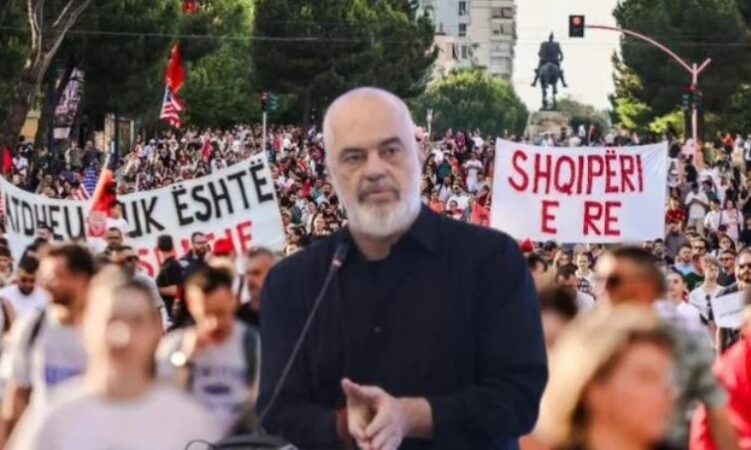



Prime Minister Edi Rama has commented on the protest and reactions to the government, demanding its resignation, linking the citizens' dissatisfaction with the growing expectations in Albanian society. Rama said that Albania has gone from a period when votes were won with promises and minimal intervention in communities, to a phase where citizens demand more from the government.
"There was a time in Albania where votes were won with gravel, meaning trucks with gravel were driven, gravel was dumped in a finished neighborhood or village and people cast their votes. They considered it a gift, for which they should be grateful. That was a time that is long gone," Rama said.
According to him, the country's development has also brought about a change in citizens' expectations. "Today, precisely because things have changed and because everything has become possible for everyone, the former theory 'it could be worse, thank goodness we're doing well' has given way to the theory 'it could be better, period, that's it'", said the Prime Minister. Rama said that this change constitutes a positive development, but at the same time makes governance more difficult. "We are entering a season of increased expectations. Tovili calls it the 'revolution of high expectations'", he said, citing the improvement of water supply as an example.
The Prime Minister also focused on the protests and the influence of social media, claiming that part of the tension has been fueled by technology.
"What they call the 'perfect storm' happened, because many components came together at one point and this gave it a kind of grandeur. It was grand, of course," Rama declared. He then spoke about what he described as interference through algorithms and social networks. "But it's another thing to see how it happens, how thousands of soldiers produced by technology laboratories, with Albanian faces and names, attack the country's digital space and create all that great tension, or more precisely, increase it," Rama said.
In his reaction, Rama also described the protest as being instigated by a "crowd of angry losers," linking the created climate to what he considers a clash between citizens' new expectations and political developments in the country.