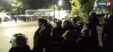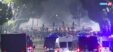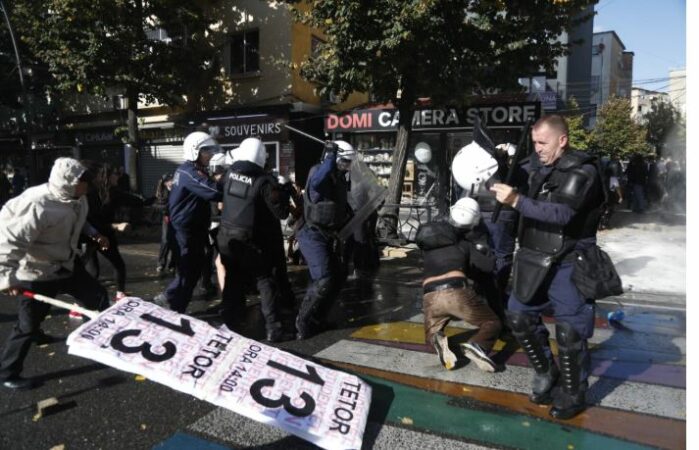



The escalation of student and citizen protests for the third consecutive day in Tirana and their spread to several other cities in the country, accompanied by violent physical clashes, massive use of tear gas and pressurized water, as well as attacks, arson and looting of public institutions and private businesses, has raised questions about the ability of the State Police to manage the situation.
Security experts, researchers and former senior police leaders assess that the response of the blue uniforms has shown significant operational deficiencies, ranging from individual violence outside protocols, to the withdrawal and leaving the center of the capital uncontrolled during the second night, to the aggressive pursuit with tear gas in residential areas on the third day. Meanwhile, the current leaders insist that the structures are acting within the law in the face of extreme aggression.
"The behavior of the State Police is strange. I can't say if they have orders or not, but the way the situation is being managed is problematic," said Gledis Nano, a security expert and former Director General of the State Police.
On the other hand, the Director General of the State Police, Skënder Hita, defended the actions of his subordinates in a telephone conversation with BIRN, stating that standard procedures are being followed, that “there is no middle ground in these situations”. Meanwhile, at a press conference, he warned that the police will not back down. “Do not confuse the restraint of the State Police with weakness”, he said.
The balance of the 72 hours of revolt
The wave of protests that has swept the country since Tuesday came after more than four months of uninterrupted peaceful rallies demanding the government's resignation, known as the "Flamingo Revolution," initially sparked in late May by opposition to tourism projects in Zvërnec.
This week, however, the protest turned into a massive revolt by students and high school students over educational conditions, the unaffordable cost of living, and the resignation of Prime Minister Edi Rama's government. The protest escalated into violence on Tuesday afternoon, and since then, clashes between protesters and police have only stopped after midnight.
Meanwhile, on Thursday, on its third day, the protest went beyond the borders of Tirana as students and high school students boycotted classes and clashed with police in Shkodër, Durrës, Elbasan, Korçë, Vlorë, Kamëz and Krujë. Meanwhile, the Albanian Parliament canceled its plenary session.
In the capital alone, the balance of three days of clashes marked high numbers of injuries, damages and arrests. On Tuesday, the protest in front of the Ministry of Education ended with 23 people being escorted by the police, of whom 16 people were arrested and 49 others were prosecuted. Meanwhile, six police officers, a journalist and at least 13 citizens who sought medical help were injured during the protest.
On Wednesday, October 14, clashes spread throughout the city, where masked protesters attacked state institutions with stones, caps and Molotov cocktails, broke into bank branches and private businesses, and attacked Police Station No. 2, where they burned a police vehicle and damaged three other vehicles. Regarding Wednesday's events, the police announced that 55 citizens, including two minors, were arrested in flagrante delicto and 98 others were prosecuted, including people accused of robbing banks and savings banks.
In a press statement on Thursday afternoon, the Director General of Police, Skënder Hita, announced that during the 72 hours of tension, the number of injured police officers has reached 71, some of whom with serious injuries. The Ministry of Health, which initially reported the number of injured people including protesters, has not made any announcements in the following days.
Criticism of the police
The way the police have reacted during these three days, criticized by the Albanian Helsinki Committee, media organizations, and Western diplomatic missions that condemned both the violence against property and the disproportionate actions of the police, is viewed with skepticism by former senior leaders of the institution itself and security researchers.
For the former Director General of the Police, Gledis Nano, the violence and especially its escalation with attacks on private businesses are completely intolerable, but he emphasizes that the State Police had the opportunity to stop this degradation and it remains unclear why it did not act in time. According to Nano, the police cannot be caught by surprise by the movements of the protesters, since in addition to the Rapid Intervention Forces, FNSH, they have operational information and are clear in advance about what can happen in such a protest.
He recalled that there are clear legal protocols that the police must implement, from shouting, to the use of water and tear gas, to the regulated way in which officers move in the field, adding that although the police do not move as quickly as the protesters, they do not have to chase them in a chaotic manner.
"This police officers breaking away from the cordon and shooting protesters with rubber batons until they fall to the ground is unprofessional," said Nano, adding that he does not believe that the officers have orders for such actions, but sees it as "a lack of training and professionalism of those officers."
"The State Police has the ability to stop the escalation of violence. I cannot say what the reasons are for not acting," he said, describing the manner of action as "strange and incomprehensible."
While the first day saw accusations of disproportionate use of force and tear gas in urban areas with residents and children, Wednesday night highlighted the opposite, a total lack of control of the territory as ministries, banks, businesses and Police Station No. 2 were attacked. Another former police and FNSH force leader, who asked to remain anonymous, said that the situation could have been managed and dealt with, but the lack of police intervention at certain moments “left much to be desired”, as on Wednesday the police at the police stations were not present on the streets until after midnight.
“The police had no control over the territory at all; I’m not saying in the whole city, but in what is known as the Small Ring Road,” said the former head of the FNSH. He explained that it is not only the FNSH that has certain tasks, but also the police of the police stations should have been engaged and present on the streets, especially after the protest dispersed, when most of the vandalism and breaking and entering also occurred, and should have been able to intervene and stop them, either through presence or through pressure.
For Romario Shehu, researcher at the Security Program at the Institute for Democracy and Mediation, IDM, the fluctuations in police behavior in these protests are closely related to the institution's internal structural problems and the long-standing public perception that the police in Albania function as an "extension of executive power", which has damaged its legitimacy, public trust and its own performance.
According to him, officers today face injustice in the rank system, lack of meritocracy, lack of psychosocial support, and long working hours, factors that directly affect how they manage tense situations.
“Long hours on duty, fatigue, psychological pressure and the constant physical attacks they face can affect employees' self-control and push them beyond permitted limits,” said Shehu, emphasizing that although the current protests in Tirana and beyond reflect this dynamic, “disproportionate police violence is not justified.”
He added that escalating situations never serves the police, so calmness, communication and self-control should be part of police professionalism even when the other side appears violent. However, Shehu sees the current clash between youth and police as a symptom of a much more serious social and institutional crisis, where a worrying normalization of violence and anger towards institutions is observed.
“It is painful to see videos of police officers beating young people, but it is equally unacceptable to see minors beating police officers,” Shehu said. “When police and young people end up in this hostile relationship, we have a much deeper problem than a protest. We have a problem of trust, of authority and of the way we are building the relationship between the state and the citizen,” he said.
But the current head of the State Police, Skënder Hita, denied that the police had different approaches or shortcomings in the operational plan during the three days, insisting that all leaders were "up to the task", that the police "are not the property of any political party" and that the use of tear gas was inevitable in the face of "a river of stone volleys".
"No one saw how many stones the police faced on the first day and everyone complained only about the police's forceful reaction. On the second day they complain that the police were less active," said Hita . / BIRN/