


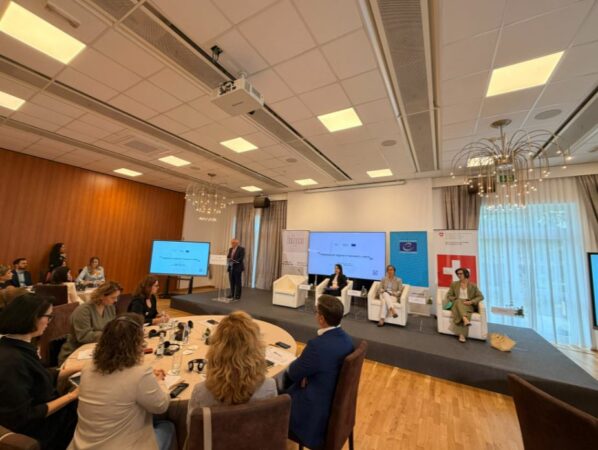



The Office of the Commissioner for the Right to Information and Personal Data Protection organized the meeting “Transparency and Integrity in Lobbying Activities”, focusing on the new legal framework for lobbying in the Republic of Albania and the package of draft by-laws that will enable its implementation in practice. The meeting was welcomed by the Commissioner for the Right to Information and Personal Data Protection, Mr. Besnik Dervishi; the Minister of State for Public Administration and Anti-Corruption, Ms. Adea Pirdeni; the Head of the Council of Europe Office in Tirana, Ms. Giulia Re; and the Ambassador of Switzerland to Albania, H.E. Ms. Siri Walt. The event was attended by representatives of public institutions, international partners and civil society.
In his speech, Commissioner Dervishi emphasized that the new framework for lobbying aims to increase transparency on how different interests and actors interact with public decision-making.
"When the word Lobbying is mentioned, the impression is often created that the conversation is taking place in a dark corridor, possibly even with heavy and closed curtains. The new legal framework, but also our objective, is to shed light on this environment and to have an institutionalized relationship," said the Commissioner. Dervishi underlined that in a democratic system it is natural for decision-makers to listen to the expertise and interests of different groups, while the problem arises when the influence remains invisible or when the opportunity to be heard is perceived as a privilege of a limited number of actors.
"In a democratic system, interests knock on the door of decision-making. But the public needs to know who knocked, for whom and for what," he emphasized.
Law No. 12/2026 “On Lobbying in the Republic of Albania” has entrusted the Office of the Commissioner with the supervision of the new framework and the competence to draft and approve by-laws. The Commissioner emphasized that this new responsibility is not disconnected from the role that the institution has been exercising for years as a guarantor of the right to information, but is directly related to the transparency, access to information and accountability of public institutions. “The right to information enables the public to know decisions and documents, while the transparency of lobbying activity makes visible the path of influences that precede decisions. Both serve a more open and accountable public government”, declared Dervishi.
During the event, a package of eight draft by-laws was presented, drafted with the expertise of the Council of Europe and funded by the Swiss Agency for Development and Cooperation. The acts specifically define the functioning and administration of the Lobbying Register, registration procedures, declaration of lobbying activity, identification and management of conflicts of interest, verification and updating of data, documentation management, as well as standards of conduct.
Commissioner Dervishi described this new area of responsibility as an institutional and regulatory challenge, noting that lobbying regulation continues to develop in other countries and that there is no unique model that can be mechanically applied in every system.
According to him, Albania should benefit from the experiences of countries that have previously established such systems, but at the same time build a mechanism that responds to the legal framework and Albanian reality.
Following the meeting, there was a discussion on lobbying transparency and integrity in decision-making from a public policy perspective, European standards and practices for the effective implementation of the legal framework, as well as the civil society perspective on transparency, participation and integrity in decision-making. Representatives of the General Directorate of Anti-Corruption, the Council of Europe and the European Movement in Albania contributed to the panel.
The activity continued with an open discussion, where participants had the opportunity to submit questions, comments and recommendations on the package of draft acts and the functioning of the new lobbying system.
The contribution of public institutions, experts, civil society, the business community and actors who will interact with the lobbying system will be important for building a functional, transparent and practically applicable mechanism.