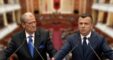



The clashes between two former associates of Prime Minister Edi Rama may fuel dissatisfaction among the socialist electorate, but journalists see no grounds for an organized movement that could threaten his control over the party.
After a long season of protests demanding his resignation, Prime Minister Edi Rama is heading towards the local elections on May 9, 2027, bearing the burden of an internal conflict with two of his former juniors in the party, Erion Veliaj and Elisa Spiropali.
At the last meeting of the Socialist Party Assembly, Rama decided to dismiss Erion Veliaj from the political leadership of Tirana and demanded the exclusion of Spiropali from the Party's leadership forums, which was later formalized with a contested vote for her exclusion from the Socialist Party's parliamentary group.
From different positions and circumstances, both Veliaj from prison and Spiropali from the presidency of the Assembly are attacking Rama's authoritarian style in leading the Socialist Party as well as his circle of ministers and directors for undeserved privileges.
But although such clashes may have an electoral effect and cost in image, few believe that the isolated positions of Veliaj and Spiropali will be able to challenge Rama's dominance in the Socialist Party.
Political journalist Luljeta Progni estimates that despite the effect of Veliaj's or Spiropali's statements among their loyalists, the way the Socialist Party functions does not leave much room for change.
"There is a way of functioning in the SP, according to which the absolute majority of the structures, but also of the electorate, goes after the one who holds the chair of the chairman," Progni told BIRN.
According to Progni, more than the emergence of two characters who have lost power within the SP as political opponents, Rama could be harmed in these elections by "the citizen reaction expressed in protest for six months."
Anila Basha, publisher of the media outlet Newsbomb, also shares the view that intra-party clashes and protests can produce dissatisfaction among the socialist electorate, but she believes that this does not necessarily translate into a loss of votes for the SP.
"Undoubtedly, the spirit of protests, combined with internal political clashes, may fuel dissatisfaction among the socialist electorate. Even some of the latest polls seem to signal a decline in support for the SP," Basha said.
However, she underlines that "there is an important difference between the political dissatisfaction of the moment and its translation into concrete electoral behavior."
According to Basha, the Socialist Party has proven to possess a stable electoral infrastructure and strong organizational discipline, which help it maintain voter support. In this regard, she notes that party affiliation and official party support for candidates continue to have considerable weight in determining the vote, often greater than the individual political capital of the competing figures.
"For this reason, I would not automatically consider today's clash as a warning of a negative electoral result for the SP in 2027," Basha emphasizes.
The electoral impact of the clash between Erion Veliaj, Elisa Spiropali and Edi Rama will depend, according to journalists, on whether the opposition to the SP leader will remain at the level of political statements or will be accompanied by concrete movements within the socialist structures and electorate.
Basha is skeptical that Veliaj and Spiropali's critical stances will become a consolidated movement within the party or produce significant electoral consequences. She attributes this to the organizational culture of the Socialists, who have historically tended "to align themselves with the party leadership rather than challenge it."
Referring to the clashes of the left over the last three decades, she notes that, despite the intensity and political consequences they have had, they have failed to create a sustainable opposition alternative within the Socialist Party.
Progni also estimates that a possible move by Veliaj and Spiropali could create a political grouping, but it will be difficult to have an impact on the future of this party.
“The 2008 constitutional changes, which introduced a closed list system for parliamentary candidates, have significantly limited the space for dissent within the party and have caused efforts to challenge Rama from within it to fail,” says Progni.
The biggest political split with electoral consequences that the SP has suffered during the transition was in 2004, when Ilir Meta, after clashes with the then-chairman and prime minister Fatos Nano, decided to break away from the party along with a group of MPs and create a new political force. In the parliamentary elections a year later, the SP moved into opposition, while Meta's LSI managed to secure representation in the Assembly.
Today's political situation is considered quite different from that of 2004, despite the weight of the two protagonists of the clash with Edi Rama. The 2004 clashes were part of an ongoing conflict between rival groups in the Socialist Party, in a party where there was more room for debate and opposition to the leader.
Progni emphasizes that unlike Nano's opponents who had a long history of clashes with him, Veliaj and Spiropali have been Rama's supporters for nearly two decades and part of his efforts to limit dissent within the party.
Consequently, Progni estimates that today's clash does not have the same political and organizational roots as the one that led to the creation of the LSI, which makes it difficult to draw a parallel between the two periods.
On the other hand, Basha admits that some superficial similarities can be identified at the level of dissatisfaction and internal clashes, but emphasizes that they are not enough to predict a structural division or electoral loss for the SP.
"If such developments were to occur a month before the elections, I would be more inclined to consider the possibility of a direct impact on the electoral outcome," she says, adding that the Socialists still have time to manage tensions and shift the electorate's attention from internal conflicts to the objectives of governance.
Basha concludes that there are no elements that would transform the 'individual dissatisfaction' of Veliaj or Spiropali into an organized political alternative, with real support beyond the names that articulate it./BIRN