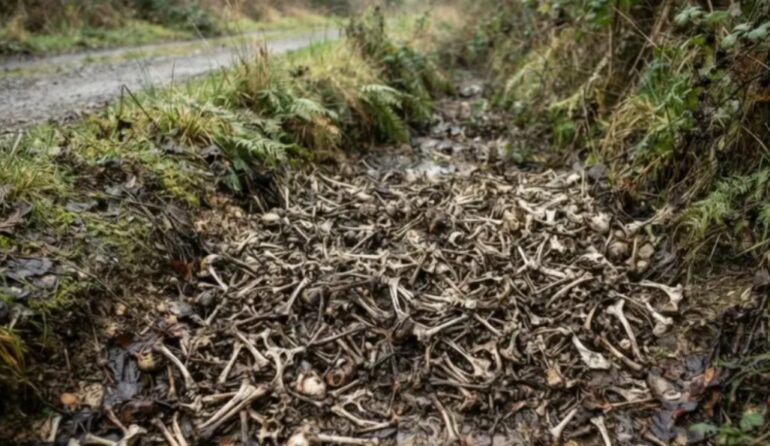



A mystery that had remained unsolved for around 1700 years has been solved by scientists in England. It concerns the deaths of around 8 frogs, whose remains were discovered in a ditch in Cambridgeshire, raising questions about the cause of this mass event.
The discovery was made by chance between 2016 and 2018, as part of work to improve the motorway linking Cambridge and Huntingdon. During the excavations, workers discovered a trench filled with thousands of amphibian bones. Researchers from Bournemouth University and the Museum of London Archaeology (MOLA) set out to unravel the mystery. Analyses, including radiocarbon dating by scientists from the University of Vienna, showed that the frogs belonged to the Roman period and that most had died at a young age.
After further study, scientists concluded that owls were responsible for the mass die-off, which had been hunting the frogs that had gathered in the area. According to a report published in the journal Environmental Archaeology, the bones of about 8 frogs had accumulated in the ditch in just one year. The researchers found that the area had provided ideal conditions for their reproduction, as the waters of the marshes and canals were receding during the Roman period.
This made the frogs more concentrated in a limited area and, consequently, more exposed to predators. Another factor that may have played a role was the changing landscape. The area, which during the Iron Age was covered with dense forests, underwent major transformations in the Roman period, when large areas of forest were cleared to create pastures for livestock.
Researchers believe that the departure of humans and their animals during the winter may have created even more favorable conditions for owls to hunt. “The mystery of these frogs has been solved — a feast of swallowed frogs and their bones left behind by a group of owls,” said zooarchaeologist Paul Clarkson. So what for centuries seemed like a mysterious mass extinction event turned out to be a natural phenomenon, linked to the presence of large numbers of frogs and the activity of predators in the area.