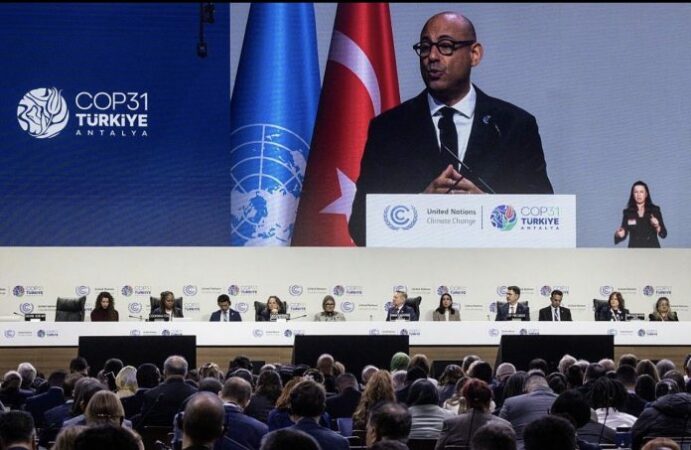



The United Nations Climate Change Conference, COP31, has entered its second day of work in Antalya, Turkey, where the focus of discussions is on financing the fight against climate change, accelerating the transition to renewable energy, and drafting concrete plans to reduce dependence on fossil fuels, according to the AP.
The conference, which began on November 9 and will continue until November 20, takes place at a time when countries face increasingly severe consequences of climate change, including heat waves, floods and extreme weather events.
UN Secretary-General António Guterres has warned that dependence on fossil fuels poses not only a climate threat, but also an economic and security risk, especially due to volatile energy prices.
One of the main issues of discussion is climate finance for developing countries.
These countries require greater financial support from developed economies to cope with the consequences of climate change, protect vulnerable communities, and invest in adaptation, without being forced to further increase public debt.
In this context, Brazil is presenting a roadmap for the gradual transition from coal, oil and gas to clean energy sources, such as solar and wind energy.
The document aims to provide countries with practical guidance for drafting national energy transition plans, taking into account the conditions and opportunities of each economy.
The initiative also ties in with the goal of mobilizing $1,3 trillion in climate finance for developing countries by 2035, according to the Baku–Belém roadmap.
Meanwhile, Turkey, the host country of the conference, is promoting a target to increase the share of electricity in global energy consumption to 35% by 2035, from around 23% currently.
The initiative aims to accelerate the electrification of the economy, but has been accompanied by discussions on the resources that will be used to produce electricity and the need for this process to rely on renewable sources.
Former US climate envoy John Kerry has stressed the need for countries to move from promises to concrete plans for implementing climate commitments.
Another important issue is protecting forests and stopping deforestation, for which Brazil is presenting a special roadmap, alongside proposals for energy transition and climate finance.
On November 11 and 12, as part of COP31, the Leaders' Summit will be held in Antalya, where heads of state and government are expected to participate.
On the agenda are discussions on the transition to clean energy, investments in the green economy, climate finance and adaptation to climate change.
Participating states are expected to face the challenge of translating international commitments into concrete measures, at a time when the objective of limiting global temperature increase to 1,5 degrees Celsius is becoming increasingly difficult to achieve.