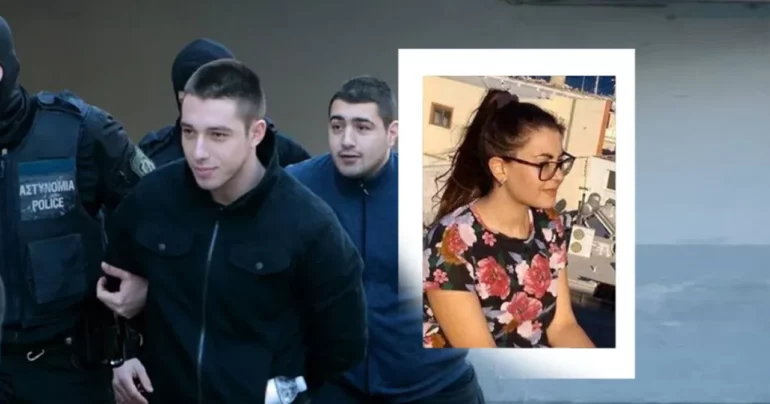



Almost eight years after the gang rape and gruesome murder of 21-year-old Eleni Topaloudi on the island of Rhodes, the case returns to the Supreme Court of Greece for consideration. On November 17, 2026, the Sixth Criminal Section will examine the request of the defense of one of the two convicts, which seeks to overturn the previous decision that upheld the final sentences against the perpetrators.
This is a last-ditch legal effort by the Greek convict, through his lawyer Haris Ambrazis. The request does not aim to reopen the trial or reassess the guilt from the beginning, but rather to examine whether the previous decision of the Supreme Court was legally correct and whether violations were committed during the handling of the case.
Evangelos Gkiugis, the legal representative of the victim's family, is also expected to be present at the hearing. At the center of the review is decision no. 747/2024, issued on May 23, 2024. At that time, the Supreme Court dismissed the requests of the two convicts for the annulment of the guilty verdicts, unanimously announced by the Court of Appeal with the Mixed Jury of Athens.
Both perpetrators were sentenced to life imprisonment for intentional murder and 15 years in prison for gang rape, without any mitigating circumstances.
After the dismissal of the requests for annulment, the sentences became final and the ordinary judicial procedure was closed. However, lawyer Ambrazis filed a new request for reconsideration, claiming that the Supreme Court's decision was erroneous.
This request relates only to his client, the Greek convict, and not to the co-author of Albanian origin. The case was first examined on 21 January 2025, but without a decision being made. The next hearing was scheduled for 17 November 2026.
In an attempt to question the extent of his client's involvement, the defense brings back some of the arguments presented during previous trials.
One of them is related to the fact that the Greek convict is left-handed. According to the lawyer, most of the wounds found on Eleni Topaloudi's body could have been caused by a right-handed person. For this reason, the defense claims that this element should be taken into account when assessing his client's role in the fatal attack.
Another argument is related to the fingerprints found on the clothes iron used during the attack. According to the defense, they belong exclusively to the other convict, of Albanian origin.
The Greek convict admits, according to his claims, that he hit the student with a "powerful punch", but denies having had the same degree of involvement in the rest of the incident.
He also claims that he did not actively participate in transporting the 21-year-old, who was in a semi-conscious state, to the sea. In support of this claim, the lawyer mentions traces of blood found on the shoes of the other convict.
Part of the request also relates to the way the trial was conducted. The lawyer claims that during the trial at the Court of Appeal, media articles critical of the defendants were read and that the extensive publicity of the case may have violated the presumption of innocence.
He also refers to public statements by officials and representatives of the authorities, which, according to him, created a perception of guilt before the end of the process.
The request also includes objections to the interpretation of audiovisual materials, their assessment in relation to the evidence, and some conclusions of the forensic expertise.
The defense also claims that digital data from the victim's devices, specifically her four cell phones and two computers, was not sufficiently examined.
These are defense claims and do not change the fact that the two defendants were convicted by the court, based on the evidence administered during the trial.
During the first hearing, in January 2025, the High Court prosecutor, Eleni Kontaktsi, had opposed the request for reconsideration. She had requested its dismissal, arguing that the Court of Appeal's decision contained full reasoning and that the evidence had been sufficiently reviewed and assessed.
According to the prosecutor, there had been no violation of the defendants' rights. Responding to allegations about the influence of media publicity, she stated that "judges are not influenced by media publications."
Eleni Topaloudi's family also opposes the defense's attempt. Her lawyer, Evangelos Gkiugis, has defended the position that both the trial, at first instance and on appeal, were conducted in accordance with the guarantees of a fair trial.
According to him, the convictions are based on sufficient evidence and the sentences given are justified. During the trial in 2022, he also focused on the two defendants' attempts to shift responsibility to each other, emphasizing that the torture inflicted on the student was related to her resistance to rape.
On November 17, the court will consider whether the request is admissible and whether there are legal grounds to revert to the 2024 decision. One of the issues that may be assessed is whether any of the concrete grounds of the previous appeal have remained unaddressed or unanswered.
If the request is rejected, decision no. 747/2024 and the final sentences of the two perpetrators will remain in force. If accepted, the Supreme Court will reconsider the legal issues for which it considers a new review is necessary.