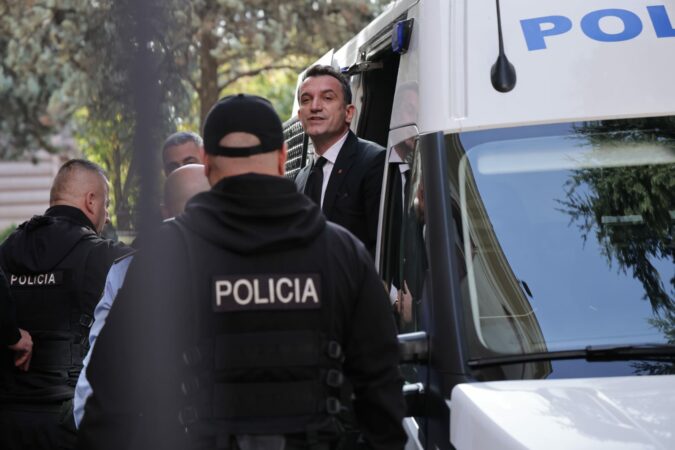



After more than 21 months in detention, the trial of Mayor Erion Veliaj appears to be stalled, with 16 of the 21 hearings postponed. Lawyers see a delaying tactic in Veliaj's defense, but add that the trial's stalling is compounded by the inefficiency of the judicial system.
In the court session on November 24, the Special Court was faced with another request from Mayor Erion Veliaj to postpone the trial due to the defendant's health problems.
The court dismissed the request and continued the process, assessing that Veliaj's request to perform a surgical intervention and select a hospital was the competence of the General Directorate of Prisons.
Arrested since February 10, 2025, Erion Veliaj has already spent 21 months in detention, after being accused of criminal offenses of corruption and money laundering.
But one of the most sensational processes of the so-called 'new justice' seems to have reached an impasse, as out of 21 scheduled sessions, 16 have been postponed for various reasons.
Added to these are 11 postponements during the preliminary hearing phase, which lasted five months, although the Code of Criminal Procedure provides for a 30-day deadline for the court to decide on the prosecution's request to send the case to trial.
Lawyers consider the high number of postponed hearings worrying, but have different opinions on responsibility for the delays and the interest the defense may have in prolonging the process.
Former prosecutor and lawyer Eugen Beçi sees in the chronology of the hearings indications of a delaying tactic by the defense, also favored by the problems of the judicial system.
“The largest percentage of postponements stem from procedural requirements and the absence of lawyers or the defendants themselves, which signals an intention to gain time,” said Beçi, who links this to an attempt to “dilute the evidence.”
Meanwhile, lawyers Dorian Matlija and Ledio Braho assess that postponements cannot be automatically considered an abuse of procedural rights and that responsibility for them should be analyzed on a case-by-case basis.
Veliaj's lawyer, Plarent Ndreca, did not respond to BIRN's questions until the article was published.
Preliminary delays
Erion Veliaj is one of the high-level politicians in Albania who is facing a trial for criminal offenses of corruption.
The Special Prosecution Office accuses him of nine counts of passive corruption, money laundering and concealment of assets in collaboration with his wife, Ajola Xoxa, and a circle of businessmen. According to the indictment, Veliaj and Xoxa set up an illegal profit scheme through a network of companies and non-profit organizations, benefiting from money and assets from businessmen who received public contracts and construction permits from the Municipality of Tirana.
Veliaj has denied the charges and has contested the legality of the investigations and the arrest measure, while claiming that his right to defense has been violated due to obstacles in familiarizing himself with the investigative file.
Delays and postponements began in September 2025 with the preliminary hearings due to the lack of lawyers, changes in Veliaj's defense, and requests for additional time to prepare the defense. The defense claimed that Veliaj had not been given access to the voluminous materials in the file. Only on February 9, 2026, after 152 days from the submission of the file to the court, did the preliminary hearing judge, Etleva Deda, decide to proceed with the trial on the merits.
Lawyer Dorian Matlija told BIRN that exceeding the legal deadline for the preliminary hearing does not constitute an isolated case at the Special Court.
“The principle of uninterrupted trial is practically not applied and in many cases preliminary hearings last for months,” said Matlija.
According to him, the responsibility for the delays is mixed and related to the behavior of the defense, the way the prosecution and the court administer the process, problems with notifications and consultations of lawyers with detained clients, as well as the overload of the judicial system.
"Under these conditions, the 30-day deadline is simply a legal illusion that cannot be implemented," he added.
The transfer of the file to trial on the merits did not bring a significant change in the pace of the process.
Of the 16 sessions postponed on the merits, six are related to the lawyers' boycott, one to the failure to notify and accompany Veliaj by the Prisons Directorate, while the other nine are mainly related to the absences of the defendants or lawyers and the procedural requests of the defense. Veliaj's controversial transfer to Fier prison has also served as a cause for the blockage, as lawyer Plarent Ndreca claims that he is facing difficulties in meeting his client.
Lawyer Ledio Braho told BIRN that a high percentage of adjourned hearings is a worrying signal for the due process of law, but added that statistics in themselves are not enough to determine responsibility.
"We need to see how long the process as a whole has lasted, how complex the issue is, why each session has been postponed, and what steps the court has taken to continue it," Braho said.
According to him, the failure to accompany the defendant by the prison authorities or the general boycott imposed by the Bar Association cannot be automatically attributed to the defendant.
The paradox of detention
One of the instruments provided by the Criminal Procedure Code to prevent defendants from benefiting from unjustified trial postponements is the suspension of pre-trial detention periods.
Article 265 of the Code provides for the suspension of these deadlines when the delays are caused by unfair actions or requests of the defendant or his defense attorney, with the exception of requests for the taking of evidence, as well as when the absence of lawyers leaves the defendant without defense.
In some of the postponed hearings against Veliaj, including those during the lawyers' boycott, the Special Court has suspended the terms of pre-trial detention. This means that, although Veliaj continues to physically remain in prison, the periods suspended by court decision are not included in the calculation of the legal terms of pre-trial detention.
In fact, if there had been no postponement of the process and in the absence of decisions to suspend the deadlines, the detention measure against Veliaj would have lost its force on September 10, 2026, one year after the file was submitted to the court. However, repeated decisions to suspend the deadlines have moved this date.
Veliaj has appealed some of the court's decisions to suspend pre-trial detention terms.
Despite the suspension of deadlines, lawyers estimate that a defendant may have other legal or tactical interests in prolonging a criminal trial.
Former prosecutor Eugen Beçi lists among them the fading of evidence and witness memory over time, the anticipation of possible legal changes, but also the reduction of public pressure on the defendant.
"The data shows that we are not simply dealing with one phenomenon, but with a double blockage, where the greatest likelihood leans towards a delaying tactic on the part of the defense, which is also favored by the slowness of the system," said Beçi.
Meanwhile, Matlija estimates that although the suspension of deadlines neutralizes the defendant's interest in benefiting from freedom from the end of these deadlines, the extension of the process may bring indirect benefits.
“Over time, the security needs may wane and continued detention becomes more difficult to justify,” he said.
However, Matlija emphasizes that it is not always possible to distinguish the legitimate exercise of procedural rights from a delaying strategy.
"The fact that a request is rejected does not mean that it was necessarily abusive," said Matlija, adding that the defense in many cases aims to oppose every step of the prosecution and not necessarily to gain time.
"In many cases, procrastination is more of a consequence than a goal," he added.
Court responsibility
The delay in proceedings in the Special Court goes beyond the "Veliaj" case, and lawyers agree that the measure of suspending pre-trial detention periods does not solve the problem.
"Suspension of detention deadlines may prevent a party from benefiting from unjustified delays attributed to it, but it does not speed up the trial itself," said lawyer Ledio Braho.
According to him, the court has the responsibility to organize a realistic calendar of hearings, to verify in advance the notification and accompaniment of defendants, and to take measures to guarantee their representation.
Meanwhile, Matlija sees the need for earlier intervention in the process, starting with the full and timely communication of the investigative file, guaranteeing the necessary time to prepare the defense, and improving coordination between the court and the parties.
According to him, what is often perceived as a delaying tactic by the defense may also be a consequence of procedural shortcomings by the prosecution and the court. For lawyers, one of the greatest risks posed by the combination of trial delays and repeated suspension of deadlines is that detention loses its character as a security measure.
“A detention that is extended indefinitely risks turning into a premature sentence,” Beçi concluded./ BIRN