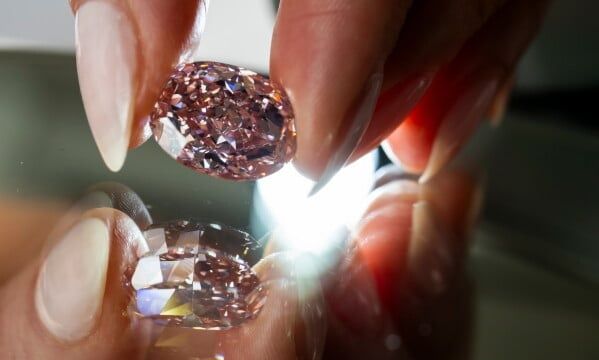



One of the rarest diamonds in the world has sold for $14.6 million at an auction held by Christie's in Geneva. Dubbed the "Bulgari Pink," the 24-carat pink diamond has been dubbed the "Mona Lisa of pink diamonds" due to its color, clarity and rarity. The gemstone had been in the private collection of the same family for more than 70 years, and its story begins in the famous Golconda mines in India. The region is known for some of the most famous diamonds in history, including the Koh-i-Noor, which adorns the crown of Queen Elizabeth, the Queen Mother.
The diamond was purchased in the 1950s by the owner's great-grandparents, who auctioned it off. It was then taken to Rome, where it was entrusted to the Italian jewelry house Bulgari to be transformed into a luxurious creation, at a time when the brand was consolidating its name in the high-end jewelry industry.
Why is “Bulgari Pink” so special?
Ahead of the auction, Max Fawcett, global head of the jewelry department at Christie's, described the stone as the "Mona Lisa of pink diamonds," a description that reflects its extremely rare characteristics. The Bulgari Pink belongs to the category of Type IIa diamonds, which contain no measurable impurities of nitrogen or boron. Moreover, natural pink diamonds are among the most sought-after in the gemstone market.
24-carat 'Bulgari Pink' diamond ring sells for over $14.6 million at auction https://t.co/4orDlJbplT
— Texoma's Homepage (@TexomasHomepage) November 11, 2026
Dr. Wei Wang, senior vice president for research and identification at the Gemological Institute of America (GIA), noted that pink diamonds are rare in themselves, but a stone of this size and quality is even more unusual. According to him, most natural pink diamonds examined by the GIA weigh less than one carat. While the “Bulgari Pink” weighs 24 carats, is classified in the “Fancy Intense Pink” color category and has a VVS2 clarity, which means it contains microscopic impurities, extremely difficult to distinguish even under magnification. Its color comes from the diamond’s unique structure and microscopic defects in the crystal lattice, known as nitrogen vacancy centers. The emerald-shaped cut, with large, open surfaces, highlights the stone’s internal characteristics and brilliance.
A 24-carat 'Bulgari Pink' diamond ring sells for over $14.6 million at Christie's auction https://t.co/Wjl7XTBqKP
— The Washington Times (@WashTimes) November 11, 2026
The history of diamonds and the golden age of Rome
The history of the “Bulgari Pink” is also linked to one of the most famous periods of the Italian capital. The 1950s marked the heyday of Rome as an international center of cinema, fashion and social life. The Cinecittà studios hosted major film productions, attracting Hollywood stars to Italy. This period was baptized with the name “Hollywood on the Tiber”. In this atmosphere, the Bulgari boutique on Via Condotti became a meeting point for the international elite. Among the famous characters who frequented this environment were Elizabeth Taylor with Richard Burton and Audrey Hepburn with Mel Ferrer. Before the sale, the diamond was expected to reach a value of 10 to 15 million Swiss francs. In the end, it was sold for 14.6 million dollars, achieving one of the highest values predicted for this extraordinary stone.
Meanwhile, the sale of the “Bulgari Pink” comes after the discovery of another rare diamond in Botswana. It is a 37.4-carat stone, which has an unusual feature: one part is pink, while the other is completely colorless. The diamond is about 2.5 centimeters long and what makes it particularly interesting is the clear border between the two parts, with the contrast between the dark pink and the transparent part.
Diamonds of this nature are extremely rare, as their formation requires very specific conditions of temperature and pressure deep within the Earth. Oded Mansori, co-founder of the company HB Antwerp, which specializes in cutting and processing diamonds, estimated that the discovered stone has the potential to become one of the most important pink diamonds ever processed. According to him, the intensity of the color testifies to the special geological conditions at the Karowe mine in Botswana, while the processing process is expected to highlight its beauty and uniqueness as much as possible.