


15 years of planning, a deception operation to hide the bombers' movements, and 37 hours in the air. The US military magazine "Air & Space Forces Magazine" has revealed details from the cockpits and planning rooms of Operation "Midnight Hammer", during which the US struck Iran's nuclear facilities in June 2025.**
It was the early morning of June 22, 2025, when two American pilots of a B-2 strategic bomber, after 18 hours of flight, were approaching targets in Iran. The lights of the city appeared below their plane, and one of the pilots, when he spotted the Iranian capital, exclaimed: “My God, it’s Tehran!”
The mission, which the crews had rehearsed and simulated repeatedly, was becoming a reality. “We’re doing it. It’s really happening,” the pilots commented, as they prepared to carry out one of the most important American air operations in recent years.
A few minutes later, the doors of the weapons bay opened and the giant penetrating bombs, weighing about 13.6 tons each, were dropped on the underground target at Fordow. After the bomber was freed from their weight, the pilots turned the plane around and looked back, expecting to see the explosion.
About 15 seconds later, a fireball rose into the sky, illuminating the Iranian mountains and turning night into day.
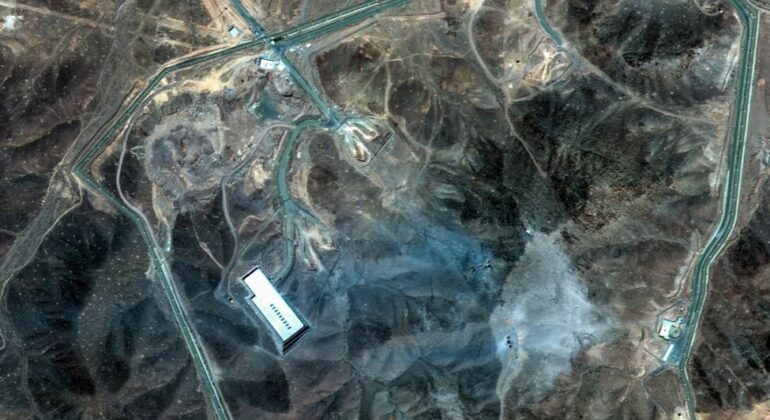
Planning to strike the nuclear facility at Fordow began in 2009, when US intelligence identified suspicious constructions in the mountains southwest of Tehran. For about 15 years, experts studied the structure of the facility, its depth and the systems that supported it.
At the center of the plan was the GBU-57 bomb, designed to penetrate fortified structures and targets deep underground. The B-2 bomber was the only American aircraft capable of carrying the weapon.
In the days before the attack, US intelligence discovered that the Iranians had attempted to seal parts of the facility with concrete, which forced planners to revise strike scenarios. Changes continued until the final hours before the mission was launched.
The deception operation to hide the bombers
One of the main challenges was keeping the departure of seven B-2 bombers from Whiteman Air Force Base in Missouri secret. To avoid revealing their destination, the Americans organized a deception operation, creating the impression that other bombers were moving towards Guam and Diego Garcia, in the Indian Ocean.
Even the pilots' families did not know where they were going. One of them, identified by the nickname "Alpha", said he had not given any information to his wife.
"I just went to work and never came back," he confessed.
The mission was an extreme test of endurance. Two pilots per plane, long hours in cramped cockpits, mid-flight refueling, and attempts to sleep in 30- to 45-minute intervals. Some used prescription stimulants, while others relied on coffee and energy drinks.
The bombers had microwaves, toilets and a small space to lie down. About 125 aircraft took part in the operation, including F-22s, F-35s, attack aircraft and flying tankers, which played a key role in refueling.
The American operation took place after Israeli attacks on Iran, launched on June 13, 2025 as part of Operation "Rising Lion".
According to the testimonies of American pilots, Israeli F-35 and F-15 jets had neutralized a significant portion of Iranian air defenses, reducing the risk to American bombers.
"They neutralized many threats and made the mission much safer for us," said the "Alpha" pilot, assessing the impact of the Israeli operation on the development of the American attack.
B-2 bombers struck nuclear facilities at Fordow and Natanz, while facilities in Isfahan were hit with Tomahawk missiles launched from a US submarine.
During the flight, the pilots heard warnings of hostile activity, but post-operational analysis showed that Iranian forces had not opened fire on the B-2 bombers.
After exiting Iranian airspace, the pilots broadcast their message: "We're done, we're safe!"
On the return flight, the crews learned that the operation had been made public and that the media was reporting on the attack. President Donald Trump had announced the strike while the bombers were still on their way back.
After about 37 hours in the air, the planes landed at their base in Missouri. The pilots were exhausted and sweaty. Some of them learned that their families had heard about the mission on television.
After brief meetings with relatives, they underwent medical check-ups, received intravenous fluids, and then participated in a classified briefing, where satellite images of the hit targets were presented.
At that meeting, some of the participants also learned for the first time the official name of the operation: "Midnight Hammer".
In total, 14 penetrating bombs were dropped, with a total weight of about 190 tons, while the target in Isfahan was hit by Tomahawk missiles.
Post-attack assessments indicate that the US strike significantly weakened Iran's capacity to enrich uranium to levels suitable for military use. However, the full extent of the damage remains unclear.
David Albright, a former UN weapons inspector and president of the Institute for Science and International Security, stated that the Iranian centrifuge program, in the form it had before the attack, has practically ceased to exist and that what remains consists largely of rubble.