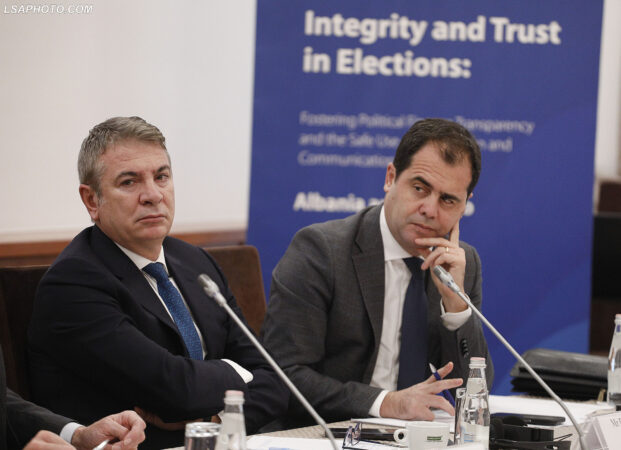



At the end of the legal deadline, the political parties in the Special Parliamentary Committee agreed to seek assistance from the OSCE-ODIHR and the Venice Commission for Electoral Reform, while experts raise concerns that the parties are creating an 'alibi' for the lack of political will to implement a reform.
At the limit of the legal term of operation of the Electoral Reform Commission, the majority and the opposition decided on Tuesday to seek the assistance of international organizations to advance with their proposals.
After a session with political debates among members, the committee decided to request an expert from the OSCE representation to assist in reviewing the legal proposals expected to be submitted by the opposition for the reform and to seek the opinion of the Venice Commission on a draft law drafted several months ago in a consensual manner on the Financing of Political Parties.
The decision to accept solutions from internationals comes as the commission is in the final weeks of its legal term of operation, while the one-year time it had available to implement the reform was spent mainly in political debates.
At Tuesday's meeting, the opposition demanded a comprehensive reform of the electoral law with the aim of separating the state from the party and preventing the use of public resources in the campaign.
The co-chair of the committee, Oerd Bylykbashi, said that the Democratic Party had a legal initiative ready that was based on the standards of the OSCE/ODIHR, the Venice Commission and the recommendations of the report for the parliamentary elections of May 11, 2025, which have highlighted the lack of equal conditions of competition, the use of public resources and pressure on administration employees.
Earlier, Bylykbashi had presented to the media, together with the party leader, Sali Berisha, a document titled "Horizontal Position - Separation of the State from the Party in the Electoral Process", outlining the points of this reform.
The DP's position stipulates that public institutions, central and local administration, public enterprises and officials should not use the authority, funds, property, personnel, information or prestige of public office to favor or harm a political entity or to influence voters.
Bylykbashi assessed that the OSCE's assistance would help the commission to advance in the remaining days of work. Socialist co-chairman Damian Gjiknuri considered the proposals articulated by Bylykbashi as "political wishes" and requested that the DP submit to the commission concrete proposals for legal provisions on which the experts could work, while expressing skepticism that a compromise would be reached in the remaining two weeks of the commission's work.
He said that the majority was open to considering any proposal that was consistent with the OSCE-ODIHR recommendations, although he expressed skepticism that "a miracle could happen within two weeks."
The Commission also decided to send for consultation to the Venice Commission a draft law drafted with political consensus on the financing of political parties, which was met with criticism from ODIHR experts and civil society organizations.
For civil society experts monitoring electoral processes, the attempt to seek solutions at the end of the commission's mandate is seen as an alibi to avoid responsibility for the failure to implement electoral reform.
The director of the Institute for Political Studies, Afrim Krasniqi, told BIRN that reform has not been a priority for any of the political parties and that, for this reason, “it was not expected that the mandate of this commission would produce real reform.”
According to Krasniqi, the request to obtain the opinion of international experts at this stage is an attempt to gain time, and not to raise the standard of reform. He emphasizes that the commission has had the budget, experts, time and mechanisms necessary to prepare concrete proposals, but has failed to produce a result.
Krasniqi argues that the parties are trying to pass the deadline and shift responsibility to each other, as they are not ready to undertake real reform on the eve of local elections. According to him, the scenario seems to aim at postponing the process and returning the commission after the elections, in the hope of negotiating a new political compromise.
"It is the responsibility of both parties to respond to the criticisms addressed in the European Commission's progress report on the implementation of this reform. The imposition of conditions that the parties impose on each other to hinder the process cannot be used as an alibi," he stressed.
He warns that the delay in the reform leaves unimplemented the ODIHR recommendations and Albania's commitment, as an EU candidate country, to guarantee elections according to democratic standards, and that the way the commission is operating does not provide any guarantee that these changes will be implemented, raising concerns about the standard of the elections.
Krasniqi considers it meaningless that the commission, despite having experienced experts and the opportunity to involve its members in drafting concrete drafts, has failed to produce a product that can be subject to discussions with interest groups.
He sees this as a "repeated failure" and as an indication of the political establishment's unwillingness to change the rules of the game.
According to him, the major parties have an interest in maintaining a monopoly over the electoral process, from competition and election administration to the selection of other structures through parliamentary negotiations, limiting the space for new parties and political competition.
"It has become a practice for commissions to be established in order not to solve problems. The time has come for commissions that are paid for with citizens' taxes to be held accountable and not simply delay processes without producing results," Krasniqi concluded./BIRN