




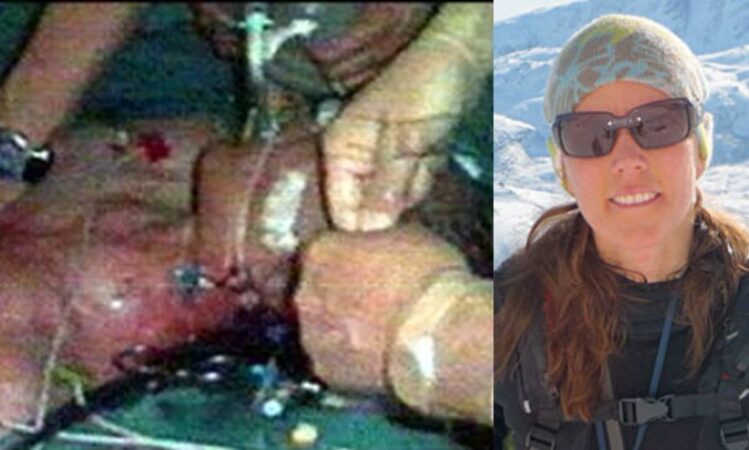



A Swedish doctor survived after her body temperature dropped to just 13.7 degrees Celsius and her heart stopped beating after a skiing accident in Norway in 1999. Anna Bagenholm’s case became one of the most famous stories in medicine, helping to expand knowledge about the protective effect that extreme hypothermia can have on the brain and vital organs. It all happened on May 20, 1999, when Bagenholm, then 29, was skiing near Narvik, northern Norway. During a steep descent, she lost control, slipped and fell into an icy mountain stream. Her head remained submerged under water, while a layer of ice about 20 centimeters thick covered her.
For about 40 minutes, she managed to stay alive by finding a space of air under the ice. She then lost consciousness. Her friends tried to pull her out, but it took about another 40 minutes to cut a hole in the ice and rescue her. When she was pulled out, her body temperature was only 13.7°C, far from the normal temperature of about 36–37°C. Her heart had stopped and, from a medical point of view, she was in cardiac arrest.
How did the doctors manage to bring him back to life?
Despite her critical condition, the medical team did not give up. During the airlift, which lasted about an hour, Bagenholm received oxygen and underwent cardiopulmonary resuscitation (CPR). At the hospital, doctors used a cardiopulmonary bypass system, which allows blood to circulate and warm outside the body, mimicking the function of the heart and lungs. After controlled warming, her heart started beating again.
The case became internationally known in the medical community after its publication in the scientific journal The Lancet in 2000. The team that cared for her in the hospital was led by Mads Gilbert, from the University of Tromsø in Norway. Bagenholm spent 60 days in intensive care, 35 of them on artificial respiration. Initially paralyzed, she underwent a long rehabilitation and gradually regained the ability to move. Five months after the accident, she returned to work and resumed skiing. Eight months after the event, according to her account, the main consequence that remained was a tingling sensation in her hands.
Under normal conditions, the brain needs a constant supply of oxygen. When blood flow stops, brain damage can begin within minutes. However, when the body gets too cold, metabolism slows down and cells need less oxygen. In Bagenholm’s case, the extreme cold of the body appears to have helped limit the damage from lack of oxygen, creating an opportunity for doctors to restore blood flow and vital functions. According to a 2014 analysis published in the journal Resuscitation, lower blood potassium concentration was the only predictor of survival identified in that analysis, which compared nine survivors with patients who did not survive. The data cited in the article also show that, between 1999 and 2013, nine of 24 patients with cardiac arrest related to hypothermia survived.
However, hypothermia does not guarantee survival, and cooling the body should not be confused with a treatment that can be carried out without medical supervision. Warming and resuscitating such patients requires specialized teams and appropriate equipment. Bagenholm, who is now 56 and works as a radiologist in Tromsø, does not remember anything from the moment she was trapped under the ice. She knows the event mainly through the accounts of her friend, Torvind, who was with her that day and later became her partner. In an interview with Metro, she said that she had lost control while skiing, had overturned and fallen into a hole in the ice. The water had filled her clothes and dragged her under.
When she woke up in the hospital, she was confused and paralyzed from the neck down. She even initially thought she had been injured during a sailing trip she had planned to Greece. “I was dead. And then I woke up. Things went back to normal very quickly,” she recalled. Recovery, however, was not easy. She could not move and could not breathe without the help of machines. After a few weeks, she was able to move a finger and then a shoulder. Mobility gradually returned to her, through a long rehabilitation process.
Bagenholm said the experience did not leave her with any major psychological consequences, but it did make her more cautious over the years. She also stressed the importance of first responders and medical professionals recognizing hypothermia. Bagenholm's survival caught the attention of doctors around the world because it showed that extreme hypothermia, under certain circumstances, can have a protective effect on the brain and vital organs.
This principle is related to therapeutic hypothermia, a method in which the body's temperature is lowered in a controlled manner to limit cell damage. Historically, some protocols have used cooling to around 32–34°C, although modern practices for post-cardiac arrest care vary according to the patient's condition and medical guidelines. Its history is related to a well-known principle in emergency medicine, especially in cases of severe hypothermia: a person who is extremely cold should not be declared dead simply because they are not showing visible signs of life, without being assessed and treated appropriately. Anna Bagenholm's case remains an extraordinary example of the combination of biological conditions, specialized medical intervention, and the perseverance of the team that fought to save her.