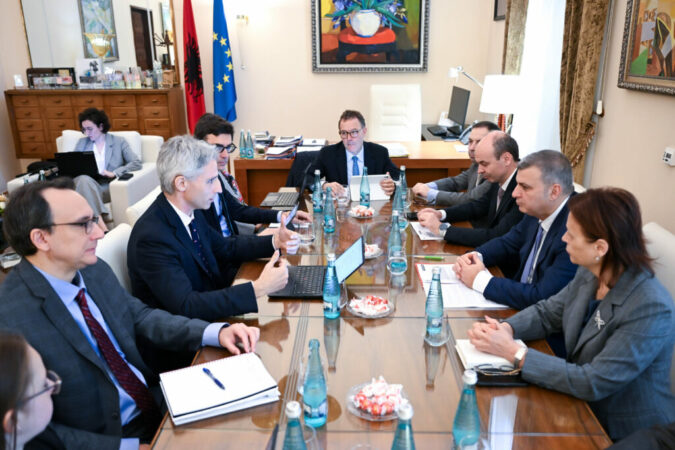



An International Monetary Fund (IMF) mission, led by Diego Cerdeiro, Chief of Mission for Albania, visited Tirana from 2 to 20 November 2026.
During this visit, the mission held meetings with representatives of the Bank of Albania from various fields, as well as a closing meeting with the Governor of the Bank of Albania, Gent Sejko, and senior managers of the institution.
The meeting discussed the latest developments in the Albanian economy, the performance of inflation and the exchange rate, as well as the state of the banking system and its role in financing the economy.
The parties also exchanged analyses on the economic outlook and on the financial sector assessment process, within the framework of the joint IMF-World Bank program (FSAP).
Governor Sejko stated that the Albanian economy continues to show stability, while consumption, investments and service activity remain supportive of economic growth. Maintaining this pace in the long term requires increasing productivity, strengthening the competitiveness of businesses and continuing structural reforms, while also taking advantage of the opportunities offered by the European integration process.
The IMF mission representatives assessed the resilience of the Albanian economy and underlined the importance of maintaining macroeconomic stability. They emphasized that the country's economic outlook remains favorable, while uncertainties in the international environment require prudent policies and strengthening the economy's capacity to withstand potential shocks.
Focusing on inflation, Governor Sejko emphasized that monetary policy remains oriented towards guaranteeing price stability.
The Bank of Albania is carefully monitoring price developments, labor market developments, and impacts from the external environment, basing decision-making on new data and economic forecasts.
The IMF mission noted that the gradual shift towards a neutral monetary policy stance was appropriate, given the cyclical position of the economy.
The performance of the banking system occupied an important place in the meeting. Governor Sejko stated that the sector remains well-capitalized and liquid, creating conditions for further supporting businesses and families with financing.
He emphasized that the premises for the continuation of lending remain positive, but this growth must go hand in hand with maintaining the quality of the portfolio and with careful assessment of the solvency of borrowers.
IMF representatives appreciated the importance of a healthy banking sector for economic development and emphasized the need for continuous monitoring of the risks associated with credit expansion.
In this regard, the role of supervision and macroprudential measures in mitigating financial vulnerabilities and strengthening the sustainability of the sector was discussed.
They welcomed the recent changes in macroprudential policy instruments, which, combined with borrower-based measures, strengthen the overall resilience of the financial system.
The parties then focused on the FSAP assessment process and its contribution to identifying priorities for further development of the financial system. Governor Sejko described this process as an important opportunity to assess progress made and to guide future reforms.
The IMF mission appreciated the cooperation with the Bank of Albania, the professionalism of the staff, and the strong commitment of the institution in support of this assessment.
The IMF mission also welcomed the adoption of the new law “On the Bank of Albania”, assessing it as an important step towards strengthening institutional independence. The mission representatives emphasized that this law strengthens the legal basis for fulfilling the mandate of the central bank and increases its ability to respond to the country's economic and financial challenges.
In conclusion, Governor Sejko thanked the mission for the discussions and continued cooperation. He reaffirmed the Bank of Albania's commitment to maintaining price and financial stability, as essential conditions for sustainable economic development and increasing the well-being of citizens./Monitor