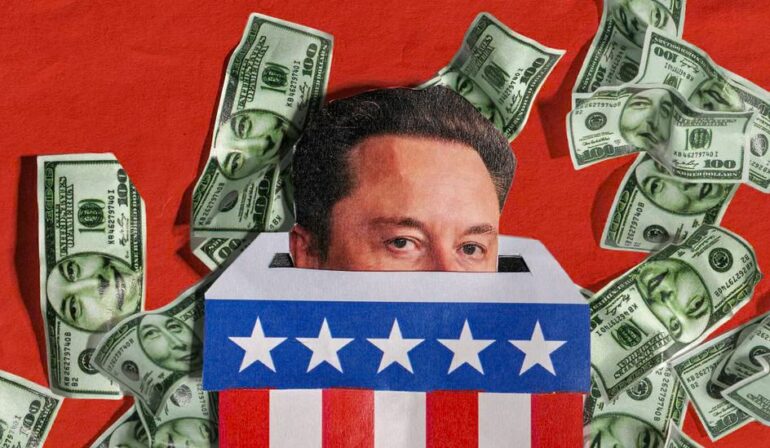



Tech billionaire Elon Musk has set a new record for funding political campaigns in the US, spending at least $446 million to support Republican candidates in the midterm elections. However, his massive investment did not yield the expected results, as Democrats won the key races where he had focused his money and attention.
The CEO of Tesla and SpaceX significantly exceeded the spending of the 2024 election, when he had invested about $290 million in support of Donald Trump and Republican candidates.
This time, Musk aimed to help Republicans maintain control of Congress, by funding at least eight Super PACs affiliated with this political force.
Of the total, at least $216 million went to his America PAC organization, while $168 million went to the Senate Leadership Fund, which supported several Republican candidates, including Ken Paxton in Texas.
But the election results proved a blow to the billionaire. Democrats won all five Senate races where America PAC had spent the most money supporting Republican candidates.
The most sensational loss was in Texas, the state where Musk has focused much of his economic and political activities. Democratic candidate James Talarico managed to defeat Republican Ken Paxton, despite millions of dollars spent against him.
America PAC spent at least $28 million on anti-Talarico ads and messaging alone. Musk also repeatedly used his X platform to attack the Democratic candidate.
After the victory, Talarico addressed the billionaires directly in his speech: "We just proved that all the money in the world is no match for the people of Texas."
Republicans also suffered losses in Senate races in Michigan, Maine, Ohio and Iowa, where organizations funded by Musk had invested tens of millions of dollars in advertising against Democratic candidates.
Although his investment did not bring the intended victory, Musk's spending contributed to the increase in campaign costs, turning some of the races into the most expensive elections in American history.
But the consequences could be even broader for the billionaire's businesses. His companies have benefited from federal contracts and a less restrictive regulatory climate during the Trump administration.
In Texas, where state authorities have supported some of his projects, the Democrats' victory could bring a more critical approach to Musk's activities.
Democratic governor-elect Gina Hinojosa has called for a moratorium on data center construction and has been embroiled in a legal battle to secure access to communications between Governor Greg Abbott's office and Musk.
Meanwhile, Democrats in the House of Representatives have announced investigations into the billionaire's activities while running the Department of Government Efficiency (DOGE), as well as examining federal funds that benefit his companies.
The electoral losses could thus mark a significant change in the relationship between Musk and American politics, raising questions about how far the influence of billionaires' money can go in the upcoming 2028 presidential election.