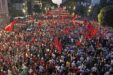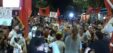




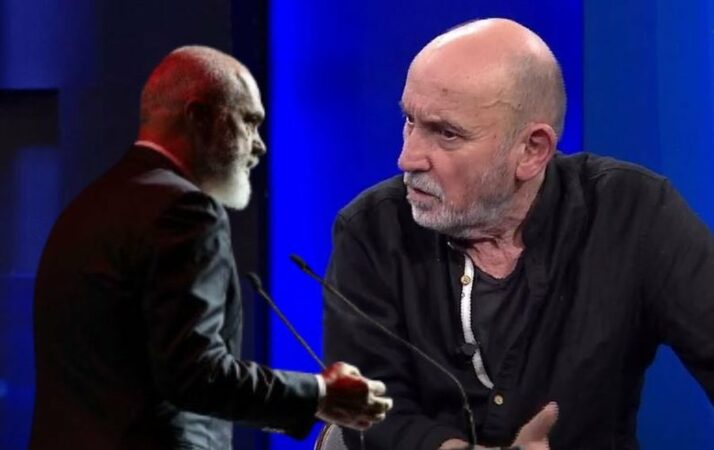



The “Flamingo Revolution” continues in Albania to protest a project supported by Jared Kushner, Donald Trump’s son-in-law. Another protest is planned in Tirana this Saturday, August 8. According to Albanian historian Fatos Lubonja, the population is expressing opposition to the kleptocratic regime in power.
By Martin Eteve, THE CROSS
Since late May, Albania has been experiencing a wave of widespread protests against a Jared Kushner-backed luxury tourism project in the protected Narta lagoon in the southwest of the country. Beyond the project itself, protesters are now also opposing the political system embodied by Prime Minister Edi Rama, in power since 2013.
How should one read the "Flamingo Revolution", which has been shaking the Albanian government for two months?
What sparked all these protests was a video showing a protester being raped in Nartë, right across from the island of Sazan, where Kushner’s project is planned. The video shows him being dragged to the ground not by the Albanian police, but by a private security group, while the official police stood by silently and did not intervene. This symbol, of a state collaborating with non-transparent organizations, is very significant.
This is not just an ecological mobilization. It is a movement that opposes a system that has been in place in Albania for 35 years, since the fall of communism.
Before 1992, Albania was the most radical communist country. From an economic point of view, it was a completely collectivized country. But it was an imposed collectivization, without socialism.
After the fall of communism, the regime that was built was one of glorifying individualism. Society does not exist, only individuals exist. Albania came to embody neoliberalism in its most extreme form. A neoliberalism in which the most powerful do not come from meritocracy, but are people close to power and members of organized crime.
Since the 90s, the government has become somewhat sophisticated, finding more subtle methods for exploiting others and deceiving, but without showing consideration for social issues.
What are the pillars on which Edi Rama's power rests?
Edi Rama has achieved what his predecessors could not: unite the oligarchs around him. They control most of the media, in a system that resembles Putin's in some ways.
On the other hand, he has integrated organized crime into his system. He has allowed the money laundering of this sector through the construction of real estate on the coast, which, according to him, is completely under the control of criminal gangs. It is precisely this system that has been directly called into question by the Kushner case.
But Rama also derives his legitimacy from partnerships with what I call the "Western empire," the United States and Europe.
This is nothing new: Albania's fate has historically been determined by subordination to empires. It was the Ottoman Empire until the 19th century, Italy in the first part of the 20th century, and then the Soviet Union and China during the communist period.
Rama is the one who has known how to benefit the most from his relations with Western leaders. By appearing alongside Macron, Hollande or Meloni, he has gained great political capital.
This today materializes in the country's opening up to Western investment and military presence. In return, a rule of law had to be built.
On paper, we're fine. We have a kind of political pluralism, we have media, we have more or less a free market and a somewhat functional civil society. But the reality is different.
How is the West's renewed support for Edi Rama explained, despite these shortcomings?
The West has not had the objective of building a rule of law in Albania. It has wanted Albania as a subordinate state, for its own geopolitical reasons.
And Rama has understood this very well. He has offered to host migrant camps requested by Italy, inaugurated a NATO base, and hosted Iranian adversaries at the request of the United States.
The European Union tolerates things it would not tolerate anywhere else.
What Rama has done in Albania is somewhat similar to what Orbán has done in Hungary, if we leave aside his anti-immigration stances.
And while the Hungarian president has been sanctioned several times, Albania's accession process to the European Union has not been called into question.
The Rama system is a reflection of a trend that we are also seeing emerge in the West: the personalization of politics, the managerial mode of governance, and the questioning of democracy.
The situation in Albania is the result of the disease of the Western model, which affects a country with a very vulnerable democratic immune system.